
Great-grandson of Meli founder puts innovative battery company on the map
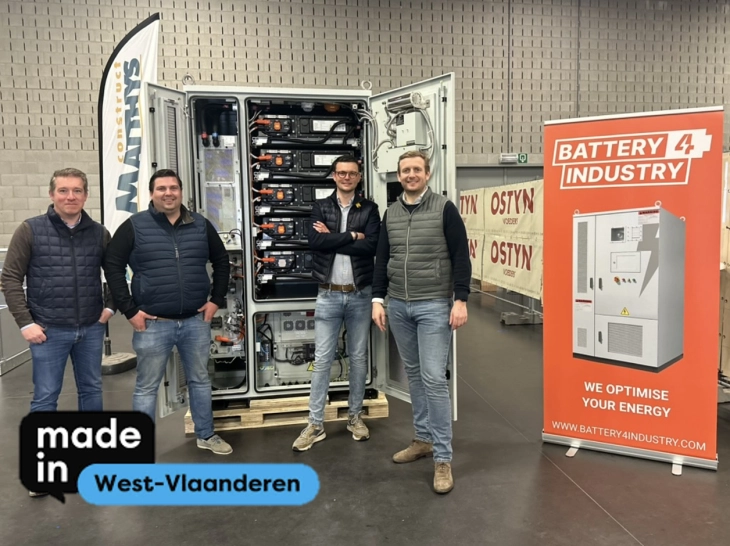
To meet the growing demand for efficient battery systems, four entrepreneurs founded BATTERY 4 INDUSTRY. The company quickly gained the trust of a publicly listed global player in solar energy and battery storage, becoming the official Belgian importer of their TIER 1 battery systems, with capacities ranging from 200 kWh to 5 MWh. Under the leadership of Karel Florizoone, a descendant of Meli founder Alberic Florizoone, the company is firmly establishing itself as a specialist in industrial battery storage.
Meli, the West Flemish honey company that celebrates its 100th anniversary this year and has grown to become the number three in Europe, was founded in 1925 by the great-grandfather of Karel Florizoone. The entrepreneurial spirit that has been present in the family for four generations now continues in the energy sector, where innovation and sustainability are playing an increasingly important role.
BATTERY 4 INDUSTRY was founded through the collaboration of three parties with complementary specialisations: Batimont Solar (Edelhart Olivier and Mathias Vandaele), a well-established name in residential and industrial solar energy; Afschrift (Björn Afschrift), a family business with three generations of expertise in high-voltage and industrial electricity; and Karel Florizoone, a young entrepreneur who gained experience at a forward-looking energy supplier and battery manufacturer.
“We see that energy storage is becoming increasingly important in the current energy transition, but also that companies are looking for specialised knowledge and integrated solutions in a fragmented market,” says Karel Florizoone. “By joining forces, we can address this challenge more effectively.”
An integrated approach
The collaboration is intended to result in a unique synergy in which all aspects of a battery project are managed in-house. From study and design to installation and maintenance, every step is handled internally. “In addition to electrical work and any required modifications or upgrades, we also manufacture our own grid disconnection panels and have a dedicated service team to ensure customer satisfaction,” says Florizoone. “We also guide clients in choosing the right energy supplier and contract model. The right contract choice has a significant impact on both the operation of the battery and the overall energy costs. In this process, we remain fully independent from third parties, allowing us—like our clients—to seek out the most favourable contract terms.”
Batteries play a vital role
Demand for large-scale battery systems is growing rapidly. In Europe, battery deployment doubled last year, and forecasts indicate that a sixfold increase will be needed by 2030 to meet climate targets.
“Batteries play a crucial role in buffering grid fluctuations, which are increasing due to the growing share of renewable energy sources—solar and wind—in the energy mix,” explains Florizoone. “At the same time, the phase-out of nuclear power—most recently Doel 1—means we’re losing stable generation capacity. Companies that can offer flexibility are rewarded, making the business model on imbalance and capacity markets, where supply and demand fluctuations are managed and traded, increasingly attractive.
In addition, new markets are opening up, such as the intraday market and the flexibility market, which grid operator Fluvius will manage to steer capacity in specific congestion areas in exchange for compensation.”
A battery system also creates local value by increasing the self-consumption of energy produced by solar panels, wind turbines, or combined heat and power units. “Since the beginning of this year, medium-voltage grid fees have risen by no less than 39%, making it more financially attractive than ever to store locally produced energy for later use,” Florizoone concludes.
Author: Karel Cambien